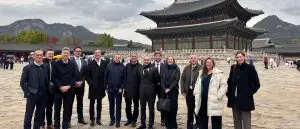




Boettcher Law attended the conference, held from 29 to 31 October 2026, with the AHK Australia delegation. This article reports what was said on critical minerals and raw materials at four sessions: a briefing by Beate Grzeski, German Ambassador to Australia; the opening panel; a circular economy breakfast; and the mining segment of the AHK lunch for Japan, Australia and New Zealand.
What did Germany say it is changing on critical minerals?
Germany says it has heard the criticism that its delegations talk and then do not invest, and has enlarged its toolbox in response. Briefing the delegation on 29 October, Ambassador Grzeski described the reputation German business carries in Australia: large, thoroughly prepared delegations, a great deal of discussion, and then nothing happens. The message Parliamentary State Secretary Stefan Rouenhoff had taken to IMARC, she said, was that the government has understood and has to be quicker and better.
She named three instruments. Germany's untied loan guarantees remain available; Germany is looking at participating in a strategic reserve; and a raw materials strategy was being prepared for release within weeks. On the opening panel the next day, the panel heard that Germany's federal raw materials fund, with a volume of one billion euros, is now operating.
She also described a shift in industry. German carmakers had said they were buyers of critical minerals, not investors. They now accept that the geopolitical position has changed, and the idea is a buyers club through which German companies source in Australia together. The briefing heard that the reason is scale: no single company can do it alone, so small and large companies need to act together.
Why has German capital not yet followed?
The ambassador was candid that, so far, German companies are not buying, and few contracts have been signed. In a market economy, she said, the government cannot make companies invest. It can set the framework conditions, and the EU-Australia free trade agreement does that by lowering tariffs and aligning standards. She expected the agreement to have a positive effect on critical minerals.
The agreement is not yet in force. A panellist at the lunch noted that negotiations concluded in March 2026. Grzeski said ratification now turns on the Australian Senate, where the government does not hold a majority and needs votes from the Coalition, the Greens or the crossbench, and then on the European Parliament; she hoped for completion in the first quarter of 2027.
On money, the gap is wide. Germany's raw materials fund has committed 50 million euros to Arafura Rare Earths' Nolans project. A participant at the briefing said that is a large sum for the German taxpayer but small against what the project needs, and would like France, Italy and Spain told where Germany has invested so they can consider backing the same project. An attendee raised the European Investment Bank's mandate to invest in critical minerals; the ambassador said that contract was not yet finalised. The United States, she said, had announced far larger commitments, though not all of that money has necessarily been paid, and Japan and Korea also work under different arrangements between government and companies. Germany is moving to a more pragmatic stance.
For an Australian project seeking German offtake, the counterparty may increasingly be a group of buyers alongside a state-backed financier, and the way such a group is put together will need careful legal review in each jurisdiction.
How does reliance on Chinese processing shape the partnership?
Every session that touched critical minerals came back to processing, and the processing is in China. At the briefing, participants said investment should go into processing rare earths in Australia, instead of shipping the material to China, where all of it is currently processed.
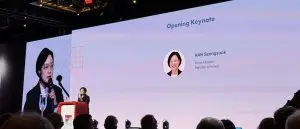
On the opening panel, the Korean panellist said that without stable access to these materials there is no secure future for semiconductors, nuclear or clean energy, and Korea depends heavily on imported raw materials. The answer had three parts: reduce dependence on any one country; treat mining, processing, refining and recycling as equally important; and cooperate, combining Germany's engineering, research and testing with Korea's sourcing and large-scale production. A business speaker said relying on a single source in China will probably not work.
At the lunch, Grzeski put the security case commercially: between like-minded countries the question is not price alone but the assurance of no kill switch, and secure, climate-friendly products are an advantage Germany should use.
What do equipment suppliers to Australian mines need to get right?
Australian standards and local assembly. Jens Dallendoerfer, Regional CEO of Wilo AMEA (Asia, the Middle East and Africa), told the lunch that Wilo cannot simply ship equipment from China to Australia. It needs at least local assembly to adjust pumps and electrical devices to Australian requirements, and Australia is strict on these regulations.
Wilo hesitated before entering mining, he said, after a public controversy over a German supplier's delivery to an Australian coal mine. It concluded that the digital and energy transitions are impossible without mining, and wrote down what it does and how it would defend that work. Australia is now a large market for its dewatering pumps, where energy efficiency and water reuse matter because power at mine sites is limited.
He named two further pressures: delivery times from Europe, slower since the pandemic, and buyers' views on where equipment is made, with products from Wilo's Korean plant the most readily accepted. Australia's bidding processes are strict, and in some years Indonesia has been the larger market. Supply contracts into Australian mining need to allocate responsibility for standards compliance, local assembly and lead times.
Where do recycling and the circular economy fit?
Speakers at the circular economy breakfast saw recycling as part of supply security, with the infrastructure still to be built. A speaker from South-East Asia said securing the supply chain of raw materials is like securing the bloodline. Another said no region is leading on the circular economy, Europe included, and that collection and sorting hubs need government investment; the technology is simple but needs a push.
The moderator put a provocative thesis: that China's dominance in critical raw materials, and its long-standing circular economy strategy, will undermine European and Asia-Pacific ambitions. The moderator also noted that the European Union is expected to introduce product-specific requirements, including mandatory recycled content quotas and product carbon footprints, and that compliance may become a condition of market access. One panellist's view was that industry is over-regulated. Another noted that some products now last considerably longer than earlier generations, which shifts the timing of recycling.
For Australian producers selling into Europe, recycled content and carbon footprint data may become a supply contract term.
Where does Boettcher Law fit?
Boettcher Law advises German and Australian businesses on the legal work behind these transactions: cross-border structuring of investment into Australian projects, offtake and supply agreements, equipment supply and distribution contracts, foreign investment (FIRB) applications, and disputes, including international arbitration. The firm has offices in Sydney, Canberra and Frankfurt and is a Platinum Partner of AHK Australia.
APK Seoul 2026
- Boettcher Law at the Asia-Pacific Conference of German Business
- What APK 2026 heard about the EU-Australia free trade agreement
- German Defence Suppliers in Australia: APK Seoul 2026
- Doing Business in Korea and South-East Asia: APK 2026
- Chancellor Merz at APK 2026: an alliance for fair trade
- Korea-Germany cooperation: the Prime Minister at APK 2026
This article reports views expressed at the conference. It is not legal advice.