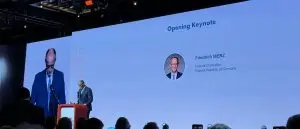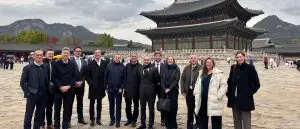




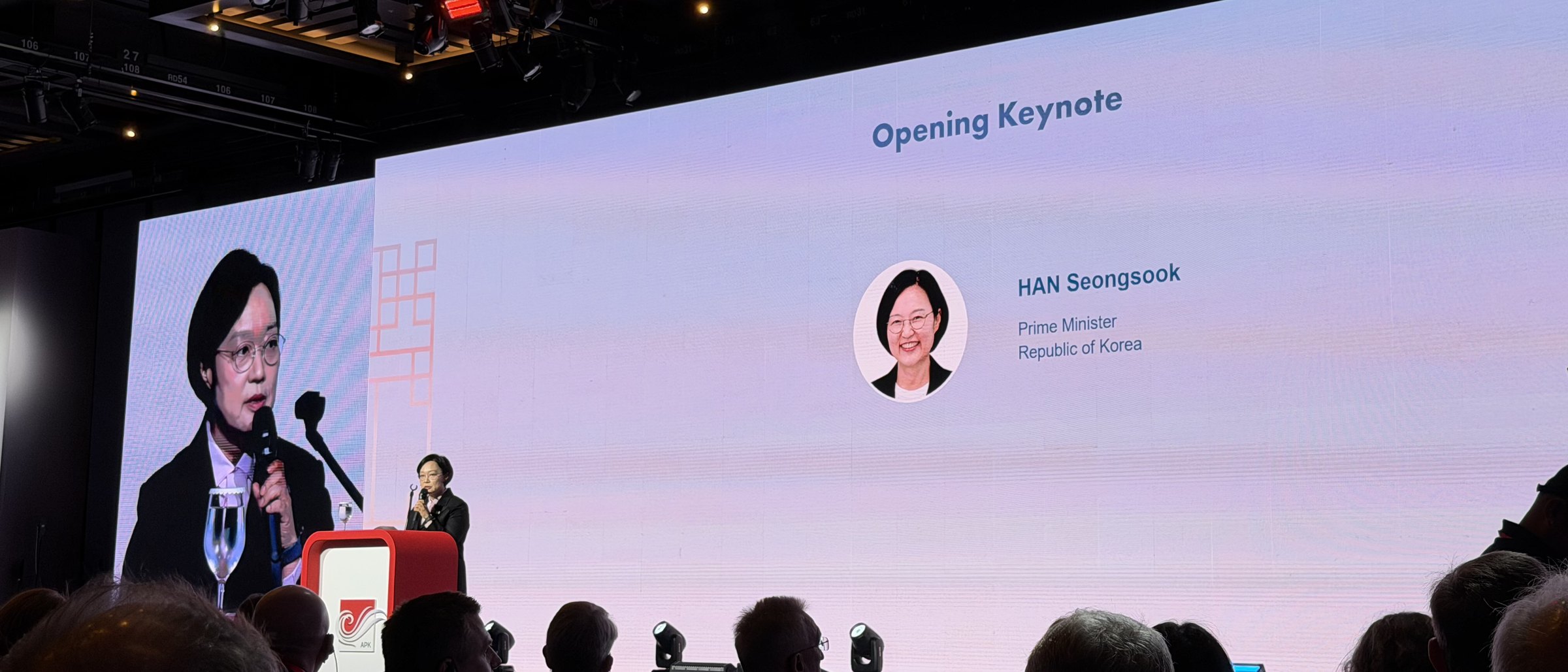
Boettcher Law attended the conference, held from 29 to 31 October 2026, with the AHK Australia delegation. The Prime Minister spoke in Korean at the opening session on 30 October. The summary below follows the official text published by the Korean government; Fabian Hoffmann's view from the Australian end comes after it.
How did the Prime Minister describe Korea-Germany cooperation so far?
As forty years of steady growth, with investment now moving in both directions. Welcoming German Chancellor Friedrich Merz and his business delegation on behalf of the Korean government, the Prime Minister noted that the conference, first held in 1986, was returning to Korea for the first time since 2007.
Over those forty years, she said, bilateral trade has grown twelvefold, and Germany is Korea's largest trading partner in Europe. About a quarter of all two-way investment to date has come in the last five years.
She gave examples from both sides. The day before, Germany's Merck had opened a production centre for biopharmaceutical materials in Daejeon. Samsung Electronics has acquired a German heating and cooling company, and Hyundai Motor Group is expanding its research facilities in Germany. She also cited joint space and hydrogen research, and the summit the previous day at which President Lee Jae-myung and the Chancellor renewed a joint declaration of intent on an energy partnership.
Why does she see connection as the answer to the AI transition?
Because, in her account, the world economy is in an AI transition whose benefits are gathering in a few companies and a few countries, which makes connection between countries more important.
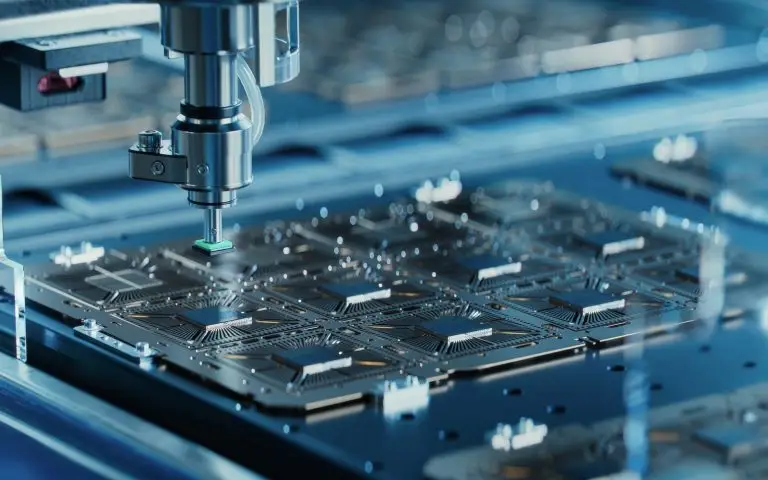
She offered semiconductors as the example of what cooperation between countries can build. The extreme ultraviolet lithography equipment that produces the most advanced chips needs German precision technology, and the Korean semiconductors made with it go back into German cars and other industries. Korea and Germany, she said, are trusted partners that raise their competitiveness by connecting their strengths, and without connection that competitiveness will be hard to sustain.
Which three fields did she single out?
Batteries, semiconductors and the AI transition in manufacturing. On batteries, she said Korean battery makers have production bases in Poland and Hungary and account for three quarters of Europe's battery cell production capacity, a foundation for the German car industry's move to electric vehicles.
On semiconductors, she pointed to ZEISS opening its first global semiconductor innovation centre in Yongin in July 2026, as cooperation already under way in both countries.
On manufacturing, she described AI as becoming a core source of competitiveness, governing productivity, quality and energy efficiency. Germany is extending the connection and sharing of industrial data through Industrie 4.0 and Manufacturing-X; Korea is accelerating through its M.AX Alliance, in which she said 1,500 companies and institutions take part. Linking the two countries' industrial data, she said, could set new industrial standards for the AI era.
What does she expect the new partnership framework to deliver?
A broader agenda, and faster government support for business. The Prime Minister said the two countries had established an enhanced strategic partnership at the summit and would sign an Economic High-Tech Partnership Framework that day. Cooperation, she said, should widen from trade and investment into supply chains, advanced technology, resources and energy, with joint research in AI, quantum, bio and space.
She described Korea as a strategic hub linking Asia, the Pacific and Europe, citing the IMF's forecast that the Asia-Pacific will drive about two thirds of world growth in 2026.
She closed on her own experience, having come to public office from the private sector about a year and a half ago. In business, growth and speed came first; in government she has learnt that close cooperation between governments is what speeds up cooperation between companies. The two governments, she said, would meet more often, cooperate faster and stand behind companies as they move ahead.
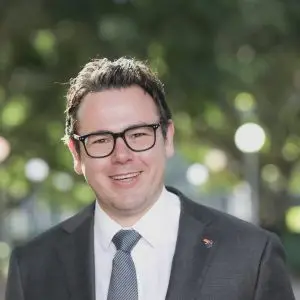
Fabian Hoffmann's view: a strong agenda that still needs its supply end and its contracts
I advise German companies in Australia and the region, and I listened from the Australian end. It was a clear and well-judged speech. The three fields she chose are genuine strengths of both countries, and her point about speed is one our clients would recognise. Some of it still raises questions a German or Australian business would ask.
The first is where Australia sits. The partnership she described is bilateral, running from German equipment to Korean chips and back into German cars, yet battery cells made in Poland and Hungary depend on raw materials mined and processed somewhere. Australia supplies raw materials and energy that Korean and German manufacturing depend on, and Korea is Australia's fourth largest two-way trading partner, with Korean investment in Australia concentrated mainly in resources. A manufacturing partnership that does not name its supply end is incomplete, and Australian producers will want to know whether the new framework reaches them.
The second is concentration. Diversification is the stated goal of German policy in the region. If Korean companies hold three quarters of Europe's battery cell capacity, a German carmaker may be exchanging one concentration for another, however trusted the partner. For a buyer, diversification is written into contracts: second sources, allocation clauses and an answer to what happens when one plant stops.
The third is how far a framework binds anyone. A strategic partnership, a partnership framework and a declaration of intent set a direction between governments. A company building a plant in Korea, or a battery maker supplying a German carmaker, relies on its contract, its security and whatever investment protection applies to it. I would want to see what the new framework adds that a business can rely on.
The fourth is data. Linking Manufacturing-X with the M.AX Alliance is an attractive idea, but industrial data is a company's know-how in another form. Before it is shared, someone has to settle who owns the data and the models trained on it, who may use them, and whose rules govern its transfer. Joint research in AI and quantum raises the same question about intellectual property.
Finally, speed. Close cooperation between governments helps. In my experience, what makes a cross-border deal move quickly is certainty: clear terms, an agreed governing law and a neutral forum for disputes, such as arbitration seated in Singapore. Governments open the door; the contract decides what happens once a business is through it.
Where does Boettcher Law fit?
Boettcher Law advises German businesses in Australia and the Asia-Pacific on cross-border structuring, commercial and technology contracts, and disputes, including arbitration seated in Singapore. Fabian Hoffmann is an Australian barrister and solicitor and a German Rechtsanwalt. The firm does not advise on Korean law; a matter that turns on it needs Korean counsel. Offices are in Sydney, Canberra and Frankfurt.
APK Seoul 2026
- Boettcher Law at the Asia-Pacific Conference of German Business
- Critical minerals at APK 2026: Germany and Australia
- What APK 2026 heard about the EU-Australia free trade agreement
- German Defence Suppliers in Australia: APK Seoul 2026
- Doing Business in Korea and South-East Asia: APK 2026
- Chancellor Merz at APK 2026: an alliance for fair trade
This article reports views expressed at the conference and the author's own view. It is not legal advice.