






Where does the EU-Australia free trade agreement stand?
The negotiations are finished, and the agreement now waits on ratification, first in Australia and then in the European Parliament. That was the account of Beate Grzeski, Germany's Ambassador to Australia, at a briefing for the AHK Australia delegation on 29 October and on stage at the AHK lunch for Japan, Australia and New Zealand on 31 October. She said the negotiations began in 2018. Angelika Yates, a partner at Addisons, speaking on the defence panel at the same lunch, placed their conclusion in March 2026.
In Australia the question is the Senate. The Ambassador said the government does not hold a majority there and needs further votes, which must come from the Coalition, the Greens or the crossbench. In her assessment the contest is less about agriculture or the climate provisions than a domestic power game. She noted that no free trade agreement has yet failed in the Australian Parliament, and that Minister Farrell regards this one as a deal Australia should take. She expressed the hope that ratification could be completed in the first quarter of 2027.
On substance, she said the agreement lowers tariffs and should help standards to be accepted in both directions. She called it a political signal that Australia, which needs to diversify, is looking to Europe. She was equally clear on its limits: in a market economy a government sets the framework conditions, lowers tariffs and aligns standards, but it cannot make companies invest. She expected the agreement to have a positive effect on critical minerals, and in the same discussion it was noted that Germany's raw materials fund is a German instrument, not a European one.
What is in dispute about the sustainability chapter?
The trade and sustainable development chapter makes labour and climate commitments binding, and that is part of the Australian domestic debate. The Ambassador explained that modern EU agreements, such as the one with New Zealand, carry climate provisions and the labour standards of the International Labour Organization as legally binding obligations, not political declarations. In substance she did not expect them to cause Australia difficulty, pointing to its standing commitments under ILO instruments and the Paris Agreement. Politically, she said, the game has not yet been completed.
What did the EU-New Zealand free trade agreement show?
Joerg Schmidt, chief executive of the German New Zealand Chamber of Commerce, presented the EU-New Zealand free trade agreement as evidence that these agreements move trade figures quickly. He said it entered into force on 1 May 2024. In the last year, on his figures, New Zealand's exports of goods and services to the European Union rose by 29 per cent, and its exports to Germany by roughly 20 per cent. He described Germany as New Zealand's largest trading partner within the EU, with agriculture, clean technology and specialised manufacturing as the main fields.
He noted that Japan's agreement with the EU dates from 2019, leaving Australia the last of the three to complete the process. Asked whether Australia was late, the Ambassador answered: "Better late than never."
What was said about ASEAN, Indonesia and India?
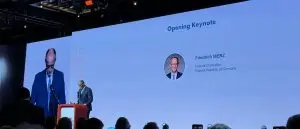
Speakers described a widening network of EU agreements in Asia, with India the market most often singled out. The Ambassador reported that Federal Chancellor Friedrich Merz, in his opening speech, called for more free trade agreements, bilateral and regional, including between the EU and ASEAN, and had referred to the CPTPP in a speech in Singapore days earlier. In the German keynote at the opening session, the speaker said he had personally helped bring the negotiations with India and Australia to a conclusion, and that these agreements must now be truly implemented.
At the session on trade scenarios for 2030, Rajiv Biswas of Asia-Pacific Economics described the EU's free trade agreements with Asia-Pacific countries as the platform for German export growth, naming new agreements with Australia and Indonesia and a further agreement in train with the Philippines. He said the EU-India agreement had only just been concluded and, once ratified, should significantly reduce trade barriers. His projection was that growth in German exports over the next decade would come from India, not China.
On ASEAN, Cyn Young Park of the SEACEN Research and Training Centre said the region has served Germany as a supply base more than as a market, that intra-ASEAN trade has stagnated, and that gaps in infrastructure and digital connectivity hold back integration. At the AHK lunch on Indonesia, Malaysia and Singapore, Dr Monika Erath, Executive Director of AHK Indonesia (EKONID), described market entry there as difficult, protective and expensive, citing export controls, bans on exporting unprocessed ore, a frequently changing legal landscape and opaque bidding processes. Entry, she said, needs a local presence, the right partners and a long-term view.
What do the trade scenarios for 2030 assume?
The main-line scenario presented in Seoul was neither a return to open trade nor a collapse into blocs, but continued friction in which trade keeps growing. Patrick Bernau of the Frankfurter Allgemeine Zeitung, who presented first, said the world would not become friendlier, but that many countries now understand the value of trade and do not want to endanger it. In that world trade is less predictable and more expensive and absorbs management attention, while diversification brings new trading partners.
The opening panel pointed the same way. One panellist said the first half of 2026 saw the fastest growth in world trade for 15 years, leaving aside the rebound after COVID, despite United States tariffs. On the same panel, globalisation was described as changing its shape, not reversing: companies with several sites and several options adapt faster.
How is an agreement used once it is in force?
A trade agreement helps only the businesses that use it. A panellist closing the lunch on Indonesia, Malaysia and Singapore put it in one line: "even the best agreement is useless if it is not used". Jeffrey Robinson, Australia's Ambassador to the Republic of Korea, gave the Korean example: bilateral trade between Australia and Korea has doubled since their agreement was concluded.
For a German business trading with Australia, four practical points arise:
- Ratification timing was given in Seoul as a hope, not a date, and the Senate vote is still to come.
- Whether particular goods benefit from a tariff preference depends on the terms of the agreement, so each product line needs to be checked once the final text applies.
- Supply and distribution contracts that deal with prices, duties and delivery terms affect which party benefits from a tariff saving.
- Investment in critical minerals was discussed in Seoul as turning on company decisions and on national instruments such as Germany's raw materials fund, not on the agreement alone.
Where Boettcher Law fits
Boettcher Law advises German and Australian businesses on the contracts through which trade agreements are used. That covers cross-border sale, supply and distribution agreements, including the clauses on price, duties and Incoterms; rules of origin questions, worked through with the client's customs adviser; and disputes, including arbitration seated in Singapore. Tariff classification, the origin determination itself and customs declarations are the work of a licensed customs broker or customs adviser, and the GST and transfer pricing consequences of a changed supply chain need a tax adviser. We work alongside both.
Fabian Hoffmann attended APK 2026 in Seoul as a member of the AHK Australia delegation. Boettcher Law is a Platinum Partner of AHK Australia.
APK Seoul 2026
- Boettcher Law at the Asia-Pacific Conference of German Business
- Critical minerals at APK 2026: Germany and Australia
- German Defence Suppliers in Australia: APK Seoul 2026
- Doing Business in Korea and South-East Asia: APK 2026
- Chancellor Merz at APK 2026: an alliance for fair trade
- Korea-Germany cooperation: the Prime Minister at APK 2026
This article reports what was said at the 19th Asia-Pacific Conference of German Business. It is not legal advice.